
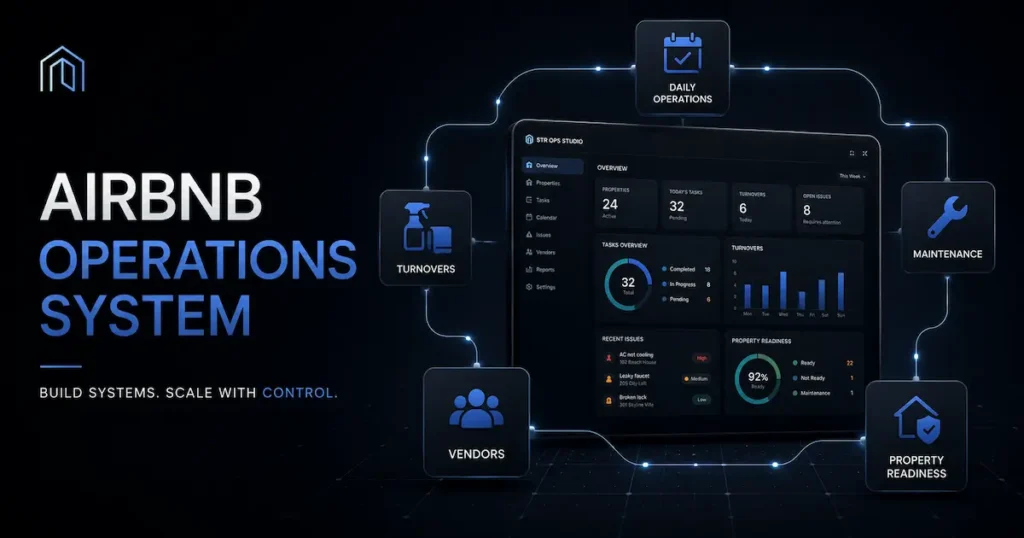
Running one Airbnb can feel manageable.
You answer guest messages, coordinate cleanings, handle maintenance issues, track expenses, and keep most of the operation under control.
But as the business grows, everything changes.
More properties mean more turnovers, more cleaners, more vendors, more guest communication, more maintenance issues, and more decisions competing for your attention.
What once worked through memory, messages, notes, and disconnected spreadsheets slowly becomes harder to control.
Tasks get missed. Information becomes scattered. Problems take longer to solve. And the operator becomes the only person who truly knows how everything works.
This is where many short-term rental businesses begin to struggle.
Not because they lack bookings.
Not because they lack effort.
But because growth has increased operational complexity without creating the structure needed to manage it.
Growth doesn’t create operational chaos. It exposes the lack of systems that was already there.
A professional Airbnb operations system creates that structure.
It connects workflows, responsibilities, information, and performance tracking so the business can operate with greater consistency, visibility, and control.
In this guide, we’ll explore what an Airbnb operations system really is, why it becomes essential as your business grows, the seven core areas every system should include, and how to build one step by step.
Because sustainable growth is not about doing more.
It’s about building better systems before complexity takes control of the business.
In This Guide
What Is an Airbnb Operations System?
An Airbnb operations system is the structure that connects the people, processes, workflows, and information required to run a short-term rental business consistently.
It defines how recurring tasks are managed, how responsibilities are assigned, where important information is stored, how problems are tracked, and how performance is monitored.
Without a clear system, operations tend to depend on individual effort.
The host remembers what needs to be done. The cleaner receives instructions through messages. Maintenance issues are tracked in different places. Vendor information lives in emails or contact lists. Important decisions depend on whoever happens to know the answer.
This approach may work when managing one property or a small number of reservations.
But it becomes increasingly fragile as the business grows.
A professional Airbnb operations system replaces scattered information and reactive decision-making with organized workflows and repeatable processes.
Instead of asking:
What needs to be done today?
Who is responsible for this task?
Has this issue been resolved?
Where can I find that information?
the system provides visibility and structure.
Everyone involved in the operation can understand what needs to happen, when it needs to happen, and who is responsible for making it happen.
The goal is not to eliminate human involvement.
It is to create an operational framework that allows people to work more consistently and make better decisions.
The Difference Between Tools and Systems
One of the most common mistakes in Airbnb operations management is assuming that having more tools automatically creates a better-managed business.
It doesn’t.
A spreadsheet can track information.
A checklist can organize tasks.
A messaging app can improve communication.
A dashboard can display performance.
Each of these tools can be useful. But when they operate independently, the business can still remain fragmented.
A tool helps you complete a task. A system helps you run a business.
The difference is connection.
An effective Airbnb operations system connects daily tasks with cleaning workflows, maintenance issues, vendor coordination, property readiness, guest processes, and performance tracking.
Information moves through the business instead of remaining trapped inside disconnected documents, applications, or individual people.
This creates something that individual tools cannot provide on their own:
operational visibility.
When operators can clearly see what is happening across the business, they can identify problems earlier, delegate responsibilities more effectively, maintain greater consistency, and make better decisions as the operation grows.
That is what transforms a collection of tools into a real business system.
Why Airbnb Operations Become Harder as You Grow
Growth is usually seen as a sign of success.
More bookings, more properties, and more revenue should mean the business is moving in the right direction.
But growth also creates something that is much easier to overlook:
operational complexity.
Every new property adds more tasks, more information, more people, and more decisions to the business.
The processes that worked when managing one or two properties may begin to fail when the same operation expands.
This is not necessarily because the operator is doing something wrong.
It happens because the business has changed, but the way it operates has not changed with it.
Without structured workflows and a professional Airbnb operations system, growth increases the number of moving parts faster than the operator’s ability to control them.
More Properties Create More Operational Complexity
Every additional property creates a new layer of operational responsibility.
There are more turnovers to coordinate.
More cleaning schedules to manage.
More maintenance issues to resolve.
More vendors to communicate with.
More guest arrivals and departures to prepare.
More property information to keep updated.
And more opportunities for something important to be missed.
At first, the increase may seem manageable.
The operator works longer hours, checks more messages, creates another spreadsheet, or adds another application to solve a specific problem.
But this approach has limits.
As the portfolio grows, managing each property as an independent collection of tasks creates unnecessary complexity.
The operation becomes increasingly reactive.
Instead of working through clear processes, the operator spends more time responding to whatever problem demands attention next.
Growth has increased the size of the business, but not necessarily its operational capacity.
Information Becomes Scattered
Operational complexity becomes even more difficult to manage when information is stored across multiple places.
Guest details may be inside a booking platform.
Cleaning instructions may be shared through messages.
Maintenance issues may be recorded in a spreadsheet.
Vendor information may live in a contact list.
Property notes may exist in documents, emails, or someone’s memory.
Each individual source of information may work perfectly well.
The problem is fragmentation.
When information is scattered, finding the right answer takes longer.
Team members depend on the operator for information.
Tasks become harder to delegate.
Communication becomes less consistent.
And decisions are made without a complete view of what is happening across the business.
The larger the operation becomes, the more expensive this lack of visibility can be.
A growing short-term rental business does not simply need more information.
It needs a better way to organize, connect, and use that information.
This is where centralized operations systems create visibility across every property and every recurring workflow.
Small Mistakes Become Expensive Problems
In a small operation, a missed task may create a temporary inconvenience.
In a growing business, the same mistake can affect guests, employees, vendors, reviews, and profitability.
A maintenance issue that is not properly tracked may remain unresolved until the next guest arrives.
A missed cleaning task can delay check-in.
Outdated property information can create confusion.
Poor vendor coordination can increase costs and response times.
An unresolved guest issue can become a negative review.
None of these problems begins as a major operational failure.
They become serious because the business lacks a reliable process for identifying, assigning, tracking, and resolving them.
This is why scaling a short-term rental business requires more than additional properties, employees, or technology.
It requires an operational structure capable of handling increased complexity without depending on constant intervention from the owner or manager.
The goal is not to prevent every problem.
The goal is to build a system that makes problems visible before they become expensive.
And that begins with understanding the essential components every professional Airbnb operations system should include.
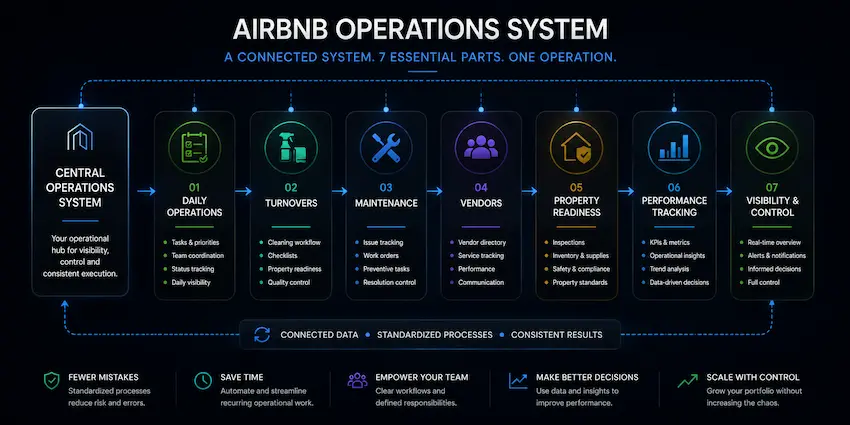
The 7 Essential Parts of an Airbnb Operations System
An effective Airbnb operations system is not built around a single dashboard, checklist, or application.
It is built by connecting the critical areas of the business into a clear operational structure.
While every short-term rental operation is different, seven core areas require consistent processes, reliable information, and clear visibility.
Together, these components create the foundation that allows an Airbnb business to operate more efficiently and grow without losing control.
1. Daily Operations Management
Every short-term rental business generates recurring tasks.
Properties need to be inspected. Supplies need to be monitored. Guest requests need attention. Operational issues need follow-up. Teams and vendors need coordination.
Without a central way to manage these activities, daily operations quickly become reactive.
The operator begins the day responding to messages, checking multiple platforms, reviewing notes, and trying to determine what requires immediate attention.
A structured daily operations system creates clarity.
It should make it easy to understand:
- what needs to be done;
- which tasks are most important;
- who is responsible;
- what has already been completed;
- and what still requires attention.
The objective is not simply to create a longer task list.
It is to create visibility across the operation so priorities can be managed before urgent problems take control of the day.
2. Turnover and Cleaning Workflows
Turnovers are among the most repetitive and operationally critical processes in a short-term rental business.
Between one guest leaving and another arriving, multiple activities must happen correctly and within a limited period of time.
Cleaning must be completed.
Supplies must be checked.
Damage or maintenance issues must be identified.
The property must be inspected.
And everything must be ready before the next guest arrives.
When this process depends on informal messages or memory, consistency becomes difficult to maintain.
A professional turnover workflow creates a repeatable process that clearly defines each stage of property preparation.
Cleaners and team members should know what needs to happen, what standards must be met, how problems should be reported, and when the property is officially ready for the next guest.
The goal is not simply to clean the property.
It is to create a reliable property readiness process that can be repeated across every reservation.
3. Guest Arrival and Departure Processes
Check-in and check-out may appear to be simple moments in the guest journey, but both depend on multiple operational details working correctly.
Arrival instructions must be accurate.
Access information must be available.
The property must be ready.
Special requests may need attention.
Departure procedures must be communicated clearly.
And the operation must know when one guest cycle ends and the next begins.
Without standardized processes, small inconsistencies can create unnecessary confusion for both guests and operators.
A structured check-in and check-out system helps ensure that important information is delivered at the right time and that every reservation follows a consistent operational process.
This improves efficiency, reduces repetitive questions, and creates a smoother guest experience.
4. Maintenance and Issue Management
Problems are unavoidable in short-term rental operations.
Appliances stop working.
Furniture gets damaged.
Plumbing issues appear.
Supplies run out.
Guests report unexpected problems.
The difference between a controlled operation and a chaotic one is not whether problems happen.
It is how those problems are managed.
Every operational issue should have a clear process for being recorded, prioritized, assigned, tracked, and resolved.
Without that structure, maintenance requests disappear inside messages, minor problems remain unresolved, and operators lose visibility over recurring issues.
A professional issue management process creates accountability.
It allows the business to understand what happened, who is responsible for resolving it, what action has been taken, and whether the problem has actually been closed.
Over time, this information can also reveal patterns that help prevent future problems and improve operational decisions.
5. Vendor Management
As an Airbnb business grows, external vendors become increasingly important.
Cleaners, maintenance professionals, plumbers, electricians, landscapers, and other service providers may all become part of the operation.
But simply having a list of contacts is not the same as having a vendor management system.
Professional vendor management requires organized information about who provides each service, which properties they support, how they should be contacted, and how their work is coordinated and evaluated.
Without a clear process, vendor relationships often depend too heavily on the owner or manager.
Team members may not know who to contact.
Response times become slower.
Important information remains scattered.
And replacing an unavailable vendor becomes unnecessarily difficult.
Centralizing vendor information and responsibilities creates greater operational continuity and reduces dependence on individual knowledge.
6. Property Protection and Readiness
A property can appear ready for guests while still containing operational risks.
Small maintenance problems, missing inventory, safety concerns, or incomplete inspections can remain unnoticed until they affect a reservation.
This is why property readiness should involve more than completing a cleaning checklist.
A professional Airbnb operations system should include processes for inspecting the condition of the property, identifying potential risks, documenting problems, and confirming that critical standards have been met.
Preventive control is especially important as the number of properties grows.
The operator can no longer personally inspect every detail or rely on memory to know the condition of each property.
A structured property protection and readiness process creates greater visibility and helps the business identify problems before guests do.
7. Performance Tracking
Operations should not only generate tasks.
They should generate information that helps the business improve.
How frequently are maintenance issues occurring?
Are the same operational problems appearing repeatedly?
Are turnovers being completed consistently?
Which properties require the most attention?
Where are delays or inefficiencies happening?
Without performance tracking, operators may stay busy without understanding whether the business is actually becoming more efficient.
This is where operations and analytics begin to connect.
A professional Airbnb operations system should make it possible to identify patterns, monitor performance, and use real operational data to improve decisions.
The purpose is not to track every possible metric.
It is to measure the information that helps the business understand what is working, what needs attention, and where improvements will have the greatest impact.
When these seven areas operate independently, managing the business becomes harder as it grows.
When they work together as part of a connected system, the operator gains something far more valuable than another collection of tools: clarity, consistency, and control.
The next step is turning these principles into a practical operational structure.
How to Build an Airbnb Operations System Step by Step
Building an Airbnb operations system does not require creating everything at once.
In fact, trying to design a perfect system from the beginning often leads to unnecessary complexity.
The most effective approach is to start with the workflows that already exist, organize them clearly, and improve the system as the business grows.
The goal is not to build the perfect system.
The goal is to build a system that people can understand, follow, and improve consistently.
Step 1: Identify Your Repetitive Workflows
Start by identifying the tasks and processes that happen repeatedly across the business.
These may include:
- preparing a property before check-in;
- coordinating turnovers;
- responding to maintenance issues;
- assigning tasks to cleaners or vendors;
- checking inventory;
- reviewing daily priorities;
- and following up on unresolved problems.
Do not begin by choosing software.
Begin by understanding the work.
Ask:
- What tasks happen every day?
- What happens before and after every reservation?
- Which problems appear frequently?
- Which activities depend too heavily on memory?
- Where do delays or confusion usually occur?
This creates a clear picture of the operational reality of the business.
Without this step, it is easy to build a system around assumptions instead of actual needs.
Step 2: Document Every Critical Process
Once repetitive workflows are identified, document how each one should be completed.
A useful process should explain:
- what needs to happen;
- when it needs to happen;
- who is responsible;
- what information is required;
- what standard defines completion;
- and what to do if something goes wrong.
The documentation does not need to be complicated.
In many cases, a clear checklist, workflow, or standard operating procedure is enough.
The important thing is that the process can be understood by someone other than the owner or manager.
If a task can only be completed correctly because one person remembers how it works, the process is not yet documented.
Good documentation reduces dependency, improves consistency, and makes delegation possible.
Step 3: Centralize Operational Information
Scattered information creates unnecessary friction.
Team members waste time searching for answers.
Tasks are repeated.
Messages are missed.
Important details remain trapped inside inboxes, applications, or personal notes.
A professional Airbnb operations system should create a central source of operational truth.
This does not necessarily mean forcing every activity into one platform.
It means ensuring that critical information has a clear and consistent place.
For example:
- property details should be stored in one organized location;
- maintenance issues should be tracked through one process;
- vendor information should be easy to find;
- cleaning instructions should be standardized;
- and task status should be visible to the people involved.
The objective is simple:
Anyone responsible for completing a task should know where to find the information required to complete it.
Step 4: Define Responsibilities and Accountability
A process is not complete until responsibility is clear.
Every recurring task should have an owner.
That person may be the host, a property manager, a cleaner, a maintenance professional, or another team member.
But someone must be accountable for moving the task forward.
Clear responsibility answers three questions:
- Who is expected to complete the task?
- Who confirms that it has been completed?
- Who follows up if it remains unresolved?
Without this clarity, tasks are often assumed to be someone else’s responsibility.
They remain open until they become urgent.
Accountability does not mean micromanagement.
It means creating enough visibility for the business to know what is happening and where support is needed.
Step 5: Track Performance and Problems
A system should not only organize work.
It should help the business learn from what is happening.
Track recurring issues, delays, incomplete tasks, response times, and operational failures.
Look for patterns.
For example:
- Is the same property generating repeated maintenance problems?
- Are turnovers regularly delayed?
- Are certain tasks frequently missed?
- Are guest issues connected to unclear processes?
- Are some vendors responding more reliably than others?
This information helps operators improve the system instead of repeatedly solving the same problems.
What gets tracked becomes visible.
What becomes visible can be improved.
Step 6: Improve the System as You Grow
An Airbnb operations system should evolve with the business.
The workflows that work for one property may need to change when the portfolio grows.
New team members may require clearer documentation.
More reservations may require better task visibility.
Additional vendors may require stronger coordination.
Growth creates new operational demands, and the system should adapt to them.
Schedule regular reviews of the operation.
Ask:
- Which processes are working well?
- Which workflows are creating confusion?
- Where are tasks being delayed?
- What information is still difficult to find?
- What should be simplified, standardized, or automated?
Do not wait until the system fails.
Continuous improvement is what keeps the operation useful as complexity increases.
The best Airbnb operations system is not the most complicated one.
It is the one people can understand, follow, and improve consistently.
Even well-designed systems can fail when they become unnecessarily complex or disconnected from the way people actually work.
Common Mistakes When Building Airbnb Management Systems
Building better systems can improve consistency, visibility, and control across a short-term rental business.
But adding more processes, tools, or technology does not automatically create better operations.
In some cases, poorly designed management systems can make the business even more complicated.
The objective should always be to reduce operational friction, create clarity, and make recurring work easier to manage.
Avoiding the following mistakes can help ensure that the system supports the business instead of becoming another problem the operator needs to manage.
Using Too Many Disconnected Tools
When an operational problem appears, the easiest response is often to add another tool.
One application manages tasks.
Another stores property information.
A different spreadsheet tracks maintenance issues.
Messages are handled through multiple communication channels.
Vendor information is stored somewhere else.
Individually, each tool may work perfectly well.
The problem appears when information cannot move easily between them.
Team members need to check multiple places to understand what is happening.
Data is duplicated.
Updates are missed.
And the operator spends more time managing tools instead of managing the business.
Before adding a new application, spreadsheet, or platform, ask a simple question:
Does this improve the existing system, or does it create another isolated place to manage information?
The objective is not to use fewer tools at any cost.
It is to ensure that every tool has a clear purpose within a connected operational structure.
Building Systems That Are Too Complicated
A system can be well designed and still fail because people do not use it consistently.
This often happens when operators try to account for every possible situation from the beginning.
Workflows become too detailed.
Checklists become too long.
Dashboards contain information nobody actually uses.
Simple tasks require unnecessary steps.
Eventually, team members begin creating shortcuts or returning to informal messages and memory.
Complexity may look professional.
But a system only creates value when people can understand and use it.
Start with the minimum structure required to manage the process effectively.
Make responsibilities clear.
Keep information easy to find.
Remove steps that do not improve visibility, consistency, or control.
Then add complexity only when the operation genuinely requires it.
The best system is not the one with the most features. It is the one people actually use.
Relying on Memory Instead of Documentation
Many short-term rental businesses operate successfully because one person knows how everything works.
They know which cleaner to contact.
They remember which property has a recurring maintenance issue.
They know where important information is stored.
They understand what needs to happen before every guest arrives.
As long as that person remains available, the operation may appear to work well.
The weakness becomes visible when they are unavailable, overwhelmed, or leave the business.
Suddenly, simple questions become difficult to answer.
Tasks are delayed.
Decisions cannot be made.
And important knowledge disappears with the person who held it.
This is why memory should never be the primary operating system of a growing business.
Critical processes, responsibilities, property information, and operational knowledge should be documented and accessible to the people who need them.
Documentation creates continuity.
It allows the business to operate consistently without depending entirely on individual knowledge.
If the business cannot operate without one person’s memory, it does not have a people problem. It has a systems problem.
Automating Broken Processes
Automation can save time, reduce repetitive work, and improve consistency.
But automation should come after the process has been clearly understood and organized.
Automating an inefficient workflow does not make it efficient.
It simply allows the same problems to happen faster and more consistently.
Before automating a process, ask:
- Is the workflow clearly defined?
- Are the necessary steps actually useful?
- Is responsibility clear?
- Does the process produce the expected result?
- Can problems be identified when something goes wrong?
If the answer is no, automation should wait.
First simplify the process.
Remove unnecessary steps.
Clarify responsibilities.
Test the workflow.
Then automate the parts that genuinely benefit from technology.
Automation doesn’t fix a broken process. It helps you repeat it faster.
Technology can strengthen a well-designed Airbnb operations system.
But it cannot replace the operational thinking required to build one.
Avoiding these mistakes creates the operational foundation required to grow with greater consistency, visibility, and control.
Once the right processes, responsibilities, and information structures are in place, the business can expand without multiplying the operational chaos that often comes with it.
How an Airbnb Operations System Helps You Scale
Scaling a short-term rental business is not simply about adding more properties.
It is about increasing the capacity of the operation without increasing complexity at the same rate.
Without the right systems, every new property adds more tasks, more communication, more decisions, and more opportunities for mistakes.
The owner or manager becomes increasingly involved in daily operations.
More time is spent solving problems.
Delegation becomes harder.
And growth begins to create pressure instead of opportunity.
A professional Airbnb operations system changes this dynamic by creating a structure that can support a larger and more complex business.
Processes become repeatable.
Responsibilities become clearer.
Information becomes easier to access.
Problems become more visible.
And the business becomes less dependent on constant intervention from the operator.
This creates several important advantages.
More properties can be managed without multiplying operational chaos.
When workflows are standardized, the business does not need to reinvent the way it operates every time a new property is added.
Turnovers, maintenance issues, vendor coordination, property readiness, and daily tasks can follow established processes.
The operation grows by expanding a structure that already works.
Delegation becomes easier and more reliable.
People can only take responsibility for work when expectations, information, and processes are clear.
Documented workflows and defined responsibilities allow team members to operate with greater independence.
The owner or manager no longer needs to provide the same instructions repeatedly or remain involved in every operational decision.
Consistency becomes easier to maintain.
Growth often creates inconsistency because more people, properties, and processes are involved.
A connected system creates shared standards for how recurring work should be completed.
This helps protect the quality of the operation as the business expands.
Problems become visible earlier.
A reactive business usually discovers problems when they become urgent.
A structured operation creates better visibility over incomplete tasks, maintenance issues, recurring failures, and areas that require attention.
Earlier visibility gives the business more time to respond before small problems affect guests, reviews, or profitability.
Decisions can be based on information instead of assumptions.
As the operation grows, intuition becomes less reliable.
There are simply too many properties, tasks, people, and variables for one person to understand everything from memory.
Connected operations and performance tracking give managers a clearer view of what is happening across the business.
This makes it easier to identify patterns, prioritize improvements, and allocate resources more effectively.
The owner or manager gains operational capacity.
This may be the most important benefit of all.
When every problem, task, and decision requires direct attention from the operator, the business cannot truly scale.
The operator becomes the limit of the operation.
Systems create the operational structure required to distribute work, information, and responsibility across the business.
This does not mean removing people from the operation.
It means allowing people to work more effectively without depending on constant supervision.
A scalable Airbnb business is not one that never experiences problems.
It is one that can identify, manage, and learn from those problems without losing control of the operation.
That is the real purpose of an Airbnb operations system.
It creates the operational capacity required to grow while maintaining visibility, consistency, and control.
Because sustainable growth is not about asking people to work harder as complexity increases.
It is about building a business that can handle greater complexity without becoming dependent on greater chaos.
Build Systems Before You Scale
More bookings do not automatically create a better business.
More properties do not automatically create a scalable operation.
And more technology does not automatically create greater control.
Sustainable growth requires structure.
As a short-term rental business expands, the number of tasks, people, decisions, and problems will inevitably increase.
The question is whether the operation is prepared to manage that complexity.
Without clear workflows, documented processes, centralized information, defined responsibilities, and performance visibility, growth can quickly become another source of pressure.
The business may generate more revenue while becoming harder to manage.
The owner may build a larger portfolio while losing more time to daily operations.
And the team may work harder without becoming more efficient.
This is why systems should come before scale.
A professional Airbnb operations system creates the foundation that allows growth to become manageable.
It gives recurring work a clear structure.
It makes responsibilities visible.
It protects important operational knowledge.
It helps problems surface earlier.
And it gives operators the visibility they need to make better decisions.
The objective is not to build a business where nothing ever goes wrong.
That business does not exist.
The objective is to build an operation that knows what to do when problems appear.
Start with the processes that create the most friction.
Document how critical work should be completed.
Create a reliable place for operational information.
Make responsibilities clear.
Track what is happening across your operation.
Learn from recurring problems.
And continue improving the system as the business grows.
You do not need to build everything at once.
You need to build enough structure to make the next stage of growth more manageable than the last one.
Because uncontrolled growth multiplies problems.
Systems create the structure that makes sustainable growth possible.
The strongest short-term rental businesses are not built by operators who can personally handle every task, solve every problem, and remember every detail.
They are built on repeatable processes, accessible information, clear responsibilities, and systems that evolve as the business grows.
Build the system first. Then scale with control.
Ready to Build a More Organized Airbnb Business?
Running a professional short-term rental business requires more than disconnected spreadsheets, checklists, and standalone tools.
It requires systems that bring structure, visibility, and consistency to every part of the operation.
STR Ops Studio creates professional Airbnb management systems designed to help hosts and property managers organize operations, improve guest experience, track performance, and scale with greater control.
Explore our Airbnb management systems and build the operational foundation your business needs to grow with confidence.
Published by STR Ops Studio
Helping Airbnb hosts and property managers build organized, scalable operations.
Professional systems for Airbnb hosts and short-term rental operators who want more control, consistency, and clarity.